

“I can’t stop eating.”
“I can’t stop drinking.”
“I can’t stop scrolling.”
“I can’t stay consistent.”
“I can’t change.”
We all have our version of this. Different words, same feeling: stuck.
And in the moment, it feels true. That’s the force of compelling emotions. They grip you so tightly it seems like you’ve lost choice.
Compulsion feels permanent. But choice always lives one layer deeper. Compulsion collapses perception (the cookie feels like the only option in the world). Awareness reopens perception (you realize you could take a breath, grab water, or walk outside instead.)
Here’s the truth: it doesn’t have to be this way. (No, you don’t have to swear off pizza forever. Yes, you can stop treating the fridge light like it’s a guiding lighthouse at midnight.)
Compulsion dresses urges up like emergencies. Awareness reminds you they’re just feelings.

Compelling vs Validating Emotions
Let’s start with the mechanics.
Compelling emotions hijack you. Urgency, craving, fear, anger. They demand action. When you’re in their grip, it feels like you’re being moved automatically.
Validating emotions steady you. Encouragement, clarity, confidence. They don’t force, they affirm. They guide you without hijacking you.
When compulsion is running the show, you don’t feel like you have control. But with awareness, you can slow down and step back into choice. (Think of it like hitting the “pause” button on a remote except the show is your life, and you’re in charge of the script.)
That’s the mechanics. But how do these emotions actually show up in your day-to-day experience? They usually appear as either encouragement or discouragement.
Encouragement vs Discouragement
Encouragement is noticing strengths and efforts despite the outcome. It’s expansive and you feel possibility. You can see options. You move with strength and clarity.
Discouragement is focusing on weaknesses and setbacks until you lose sight of possibility. It’s narrow and you feel stuck. You only see one option: the urge in front of you.
Discouragement is simply compulsion in disguise. Encouragement is validation in action.
Discouragement says, “I’ll never be consistent.” Encouragement says, “I made it to the gym, even if I didn’t crush it.”
And here’s the key: when we act from discouragement, our actions tend to be short-sighted and self-protective.
When we act from encouragement, they’re usually less self-centered and more contributive to the whole.
And that’s where it gets practical because whether we act from encouragement or discouragement, there’s always a reason behind it.
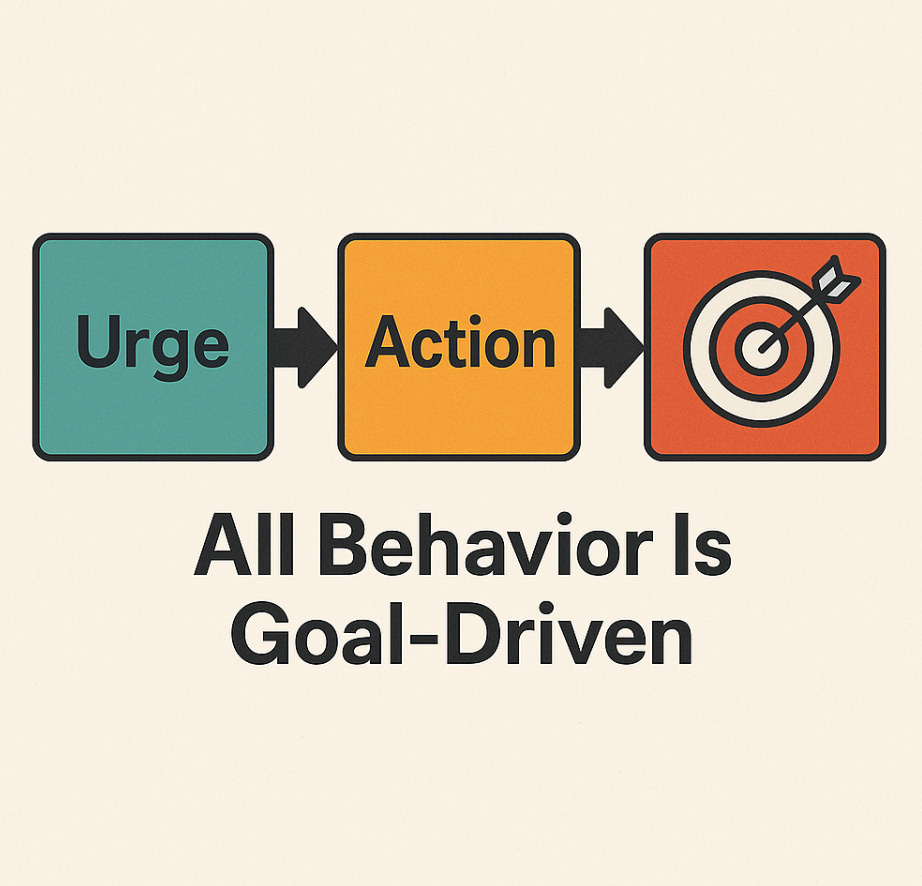
All Behavior Is Goal-Driven
Here’s the deeper truth: all behavior is goal-driven. Every action you take is an attempt to meet a need.
Every action is a solution, just not always the best one. Late-night eating solves comfort. A drink solves stress. Scrolling your phone solves boredom. Procrastinating on work solves the fear of failing. Encouragement opens the door to better solutions…ones that don’t cost you later.
So when you find yourself standing in front of the fridge at 10 p.m., or reaching for a glass of wine after a long day, it’s not about weakness. (The fridge isn’t magnetic. The wine isn’t whispering your name. It just feels that way.) It’s about seeking relief. You’ve learned to meet your emotional needs in those ways.
The answer isn’t to white-knuckle and resist. It’s to slow down and get curious: Why do I need this relief in this way? What is this urge trying to fulfill?
We don’t want to bypass the emotion, we want to recognize it, then find a more useful way to meet the underlying need.
But here’s where people often get tripped up: they confuse this kind of discernment with simple positive thinking.
Differentiating Positive Thinking and the Power of Encouragement
It’s worth clarifying the difference.
Positive thinking says: “Ignore the bad, repeat the good, and everything will work out.” It skips over reality.
Encouragement says: “See the urge. Name it. Then choose the step that serves growth.” It doesn’t bypass emotions. Instead, it works with them.
Encouragement is functional reframing, not wishful thinking. It’s not about forcing happy thoughts; it’s about choosing useful ones.
This process actually has a name in psychology: cognitive reappraisal — the ability to reinterpret what a feeling means before you act on it. That skill is like mental weightlifting: each reframe strengthens your capacity to choose a better response.

The First Key: Awareness
This is why awareness is the starting point.
You can’t override a compulsion if you don’t recognize it. The moment you notice the pull (“this is a compelling emotion”) you create space between the feeling and the action. That pause is where discernment begins. That’s where you take your power back.
Awareness is what steadies perception. Awareness reopens the lens. Courage keeps it open. And when perception steadies, you shift from Reactive Doing into Being → Responsive Doing.
In neuroscience, this pause is known as response inhibition — the brain’s braking system. Every time you pause before acting, you’re literally strengthening the prefrontal cortex, the part of the brain that gives you choice.
And here’s the part most people miss: awareness isn’t passive. It’s an active skill, like lifting a weight. Every time you notice the urge without immediately acting, you’re strengthening the muscle that separates automatic action from choice. That’s strength in motion.
(And no, awareness isn’t as glamorous as a six-pack or a PR in the gym, but it’s the thing that makes all of that actually possible. Without it, you’re just reacting.)

Here’s your rep for the week: Next time an urge hits (food, drink, skipping the gym) don’t fight it, don’t feed it. Just name it: “This is compulsion.”
Then choose encouragement. What does that look like?
Instead of “I’m weak for wanting this,” say “I’m strong enough to notice this urge before acting.”
Instead of “I’ll never change,” say “This is one rep toward change.”
Instead of “I blew it,” say “I showed up to practice awareness — and that counts.”
Encouragement reframes the moment. It doesn’t erase the urge, but it widens your choices. That single rep (notice, name, encourage) is the muscle. Build it, and everything else gets stronger.