
Show AND Go: The Smarter Way to Train for Strength That Lasts

When I first started training, I was all about the bodybuilding splits focusing one muscle group per session, chasing the pump, wrecking myself in the gym. Thankfully I never took as far as a lot of guys doing “mirror muscles only” workouts like chest and biceps.
I was in the Air Force, stationed in Iraq, with my first training book—The Encyclopedia of Bodybuilding by Arnold Schwarzenegger. I read that thing every day and then went and lived it out at the gym on base. Before long, guys were knocking on my door in the middle of the night asking for the workouts I’d written down that day. Something clicked: maybe I could actually get paid to do this.
Fast forward 15+ years, and here I am, a coach, gym owner, still a fan of bodybuilding, and still reading.
I’m literally on my way to a bodybuilding show for a client of our gym right now. I still love the sport and what it gave me. But working with real people has shown me something bodybuilding doesn’t always address: recovery, sustainability, and the bigger picture of health and strength.
That’s where training maturity comes in.
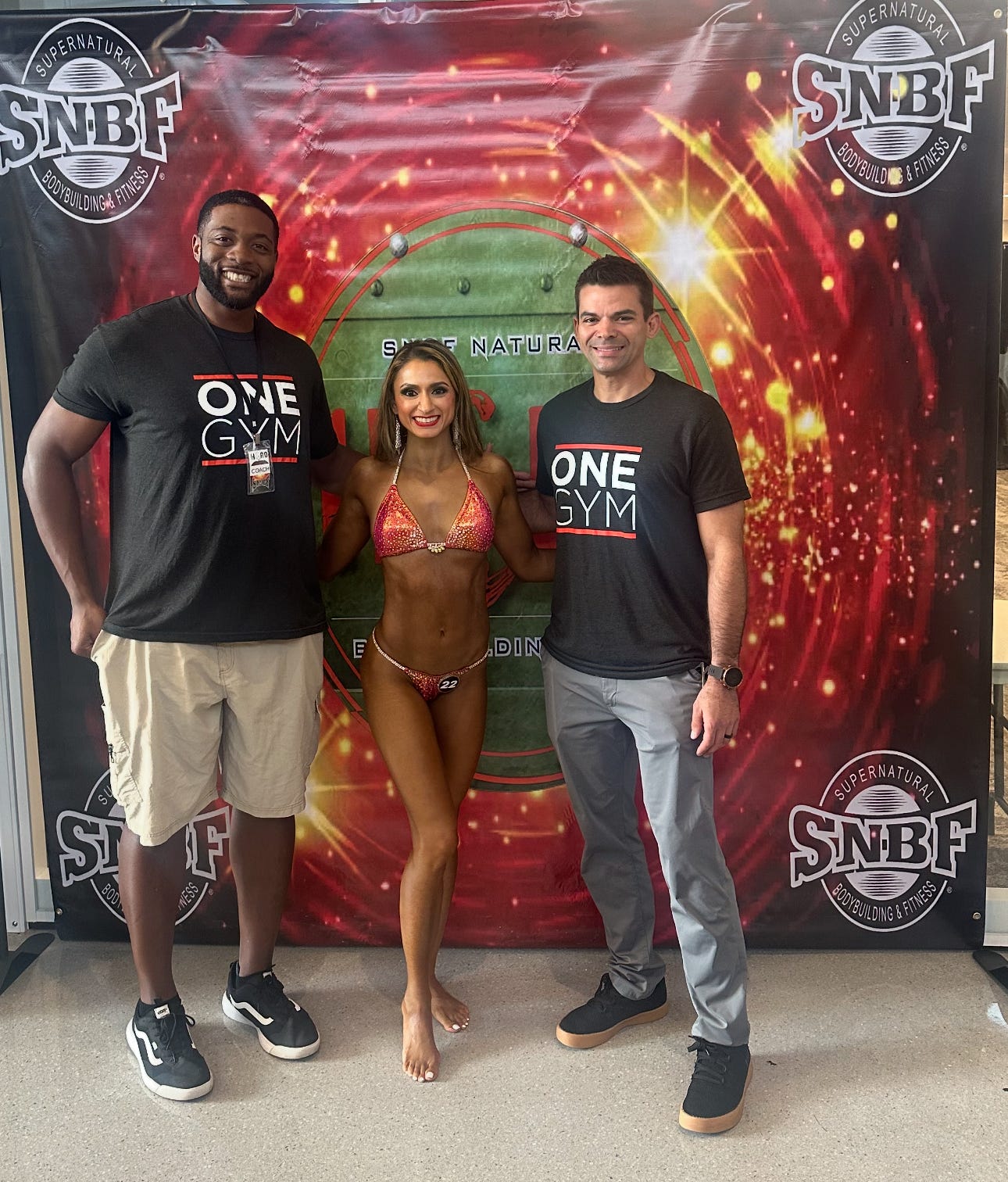
Shown above: Alex Smith, Seema Gallagher (Placed 2nd), Me (9.6.2025)
The Old Way: Chasing Soreness and Splits
We’ve all seen the programs: chest day, arm day, glute day, leg day.
Maybe you did(do) them too.
The problem? They’re built for people who can live in the gym, sleep like teenagers, and recover like machines. For the rest of us—with jobs, families, stress, and limited recovery—splits are a losing game.
Miss one day? You miss an entire muscle group. For most guys, that’s legs ;-)
Wreck your legs on Monday? You’re limping until Friday.
Chase soreness every session? You’re confusing damage with progress.
Soreness feels like proof, but it’s often just punishment.
I also think a lot of people do splits so they don’t have to work as hard (i.e. use less weight) and still feel like they did something.
The Shift: Train Movements, Not Muscles
Training maturity means moving beyond muscle-by-muscle splits and embracing primary pattern training and full body workouts.
Instead of obsessing over isolated parts, you build your workouts around the fundamental human movements:
Squat
Hinge
Push
Pull
Carry / Core
These patterns cover every major muscle group. They let you train the whole body multiple times a week without annihilating recovery. Some might variations of this could be to swap out Carry / Core with Locomotion or add a sixth exercise to your workout and pick whatever you like (ex: bicep curls, lateral raise, etc.)
Dan John (one of the most respected strength coaches alive) has been preaching this for decades:
“If it’s important, do it every day. If it’s not important, don’t do it at all.”
Of course, he’s not saying you should max out your squat daily. He’s pointing to the principle that the movements that matter most should consistently show up in your training.
And Alan Cosgrove, in The New Rules of Lifting for Women, drove home the same point:
“The best way to lose fat is to train the entire body. If you want to change your body, you need to train movements, not muscles.”
In other words, pattern-based, full-body training isn’t just for men chasing performance. It’s equally effective for women pursuing strength, health, and body composition. And it should be done consistently.
Why Primary Pattern Training Works
Frequency beats volume. Hitting muscles multiple times a week drives more growth than nuking them once.
Efficiency. Three sessions can cover everything instead of six.
Fat loss. The biggest muscle groups torch the most calories.
Function. You train the way you actually move in life—not just in front of a mirror.
Longevity. Less joint stress, less overuse, more adaptability.
Even in serious bodybuilding circles, this isn’t fringe.
Eric Helms (researcher, coach, and PhD) has pointed out that full-body or pattern-based training can be highly effective, even for physique athletes. For advanced competitors, splits can become necessary to hit extreme volume goals. But for most people (including beginners and intermediates) fewer, well-structured full-body sessions deliver outstanding results.
Charles Staley, another pioneer in efficient training, built entire systems around this principle: density, frequency, and sustainability matter more than marathon “arm blasters” or “glute burners.”
But What About the Pump?
Let’s be real: the pump is addictive. It makes you feel bigger, stronger, alive.
The truth? The pump is just blood flow. By itself, it doesn’t equal muscle growth. But when paired with progressive overload and smart programming, it can contribute to growth as part of the process.
But here’s the key: you don’t have to lose it.
Add finishers, like dropsets, rest pause, myo-reps, or even just shorter rest periods, and you’ll still get the skin-stretching effect—while keeping your body fresh enough to come back and do it again tomorrow.
And this is the moment training maturity really shows itself: shifting from chasing a temporary pump to building strength that lasts.
From Show… to Show AND Go
Looking good matters—of course it does. But what matters more is actually being strong in your body.
Which would you rather:
A physique that looks great on the beach for one summer, or the strength to carry your child on a mountain trail ten years from now?
A pump that lasts an hour, or a body that performs every day?
Vanity can start the fire, but strength keeps it burning. The real win is when you train for show and go.
A Guiding Principle
“Any fitness program will improve in direct ratio to the number of things you can keep out of it that need not be there. The things that matter most should not be at the mercy of the things that matter less.”
This is the heart of training maturity—focusing on patterns, strength, and sustainability instead of distractions that don’t move the needle.
How to Start
2–3 Short Sessions/Week: Even if you only have 30 minutes, you can run through all five patterns. I’ve had clients make tremendous progress with just 2–3 thirty-minute sessions a week using this approach.
3 Days/Week (45–60 minutes): Train all five patterns each day for a balanced, efficient full-body workout.
4 Days/Week: Alternate A/B workouts with different variations of the patterns for extra variety and volume.
Rotate exercises every 1–3 months. Keeps progress coming, boredom low, and joints healthy.
Simple. Repeatable. Sustainable.
Training maturity isn’t about doing more, it’s about doing better.
If you don’t have the time or recovery of someone who can live in the gym, stop training like it.
Build your body on patterns. Get stronger everywhere. Train for show and go.
Your Free Program
If you want a practical way to put this into action, I’ve created a free workout program that lays out exactly how to train with this method—complete with exercises, sets, and reps. It also includes a conditioning guide.
It’s the same system I use with my clients who want to look good, feel strong, and keep their training sustainable.
👉 [Download the free Primary Pattern Training Program here.]
Because the best training plan is the one you can recover from, repeat, and grow stronger on.