

Ever wondered why some habits feel effortless, while others seem impossible to stick with? Habits are your brain’s way of simplifying life to conserve energy. Think about your daily routine…when you wake up, brush your teeth, or take your dog for a walk. You likely don’t think through every step. These actions are automatic, freeing your brain to focus on other tasks.
This automation is a survival mechanism, but it’s also why changing habits can feel like an uphill battle. Your brain resists change because it craves efficiency, and building a new habit requires effort.
The key to long-term vitality lies in understanding the mechanics of habits and learning how to reshape them effectively.
Why Building New Habits is Hard
At the start of the year, many of us set bold goals: overhaul our diets, commit to daily workouts, and promise to manage stress better. Enthusiasm fuels early momentum, but as life gets busy or progress slows, old habits creep back in.
This happens because our brains are wired for familiarity. Research by Lally and colleagues (2010) shows that it takes an average of 66 days for a new behavior to become automatic. The process requires consistency and patience, which is why trying to change everything at once often leads to burnout.
Changing habits demands consistent effort, and trying to overhaul everything at once is like asking your brain to sprint a marathon.
The solution? Focus on systems, not goals, and tackle one habit at a time.
Focus on Systems, Not Goals
Instead of chasing outcomes like "lose 10 pounds" or "sleep 8 hours every night," focus on creating systems that lead to those results. Systems are about the daily actions and processes that shape your identity and outcomes over time.
Environmental cues are especially powerful. A study by Wood et al. (2002) found that habits thrive when they’re tied to specific triggers in your environment.
For example:
Rather than aiming to "run a 5K," build the habit of lacing up your running shoes and going outside each morning.
Instead of saying, "I’ll eat healthy," start with preparing one balanced meal every day.
By focusing on systems, you’re no longer dependent on motivation. You’re building the framework for lasting change.
The 1% Improvement
Think of habit change as a game of small wins. A concept explored by Amabile and Kramer (2011) emphasizes that celebrating small victories ignites motivation and builds momentum. A 1% improvement may seem minor, but compounded over time, it creates remarkable results.
For instance, drinking an extra glass of water daily won’t transform your health overnight, but over a year, it can improve hydration, digestion, and energy.
The Four Laws of Behavior Change
James Clear’s framework from Atomic Habits offers a roadmap for building effective habits:
Make it obvious: Design your environment so the habit is hard to miss (e.g., put your journal on your pillow as a reminder to write before bed).
Make it attractive: Pair the new habit with something you enjoy (e.g., listen to your favorite podcast during a walk).
Make it easy: Start small - commit to 2 minutes of meditation rather than 20.
Make it satisfying: Create a reward system that reinforces success, like checking off your progress on a tracker.
If that’s how you build effective habits, you can also flip the formula to break bad ones:
Make it invisible: Remove triggers from your environment. Keep your phone in another room during meals to avoid mindless scrolling, or store snacks out of sight in an inconvenient cupboard.
Make it unattractive: Reframe the behavior so it loses its appeal. For example, remind yourself that sugary drinks leave you feeling jittery and drained instead of energized, or think of binge-watching late at night as trading quality sleep for exhaustion.
Make it hard: Add friction to the behavior. If online shopping is your vice, delete saved payment information so it’s harder to make impulse buys. If you’re tempted to skip workouts, pack your gym bag the night before and place it where you can’t ignore it.
Make it painful: Introduce accountability or consequences. Sign up for a fitness class or get a trainer with a no-show fee to give yourself extra motivation to follow through.
Environment Design
Your surroundings shape your behavior more than willpower ever could. Wood et al.’s (2002) research underscores this: designing your environment to support your goals removes barriers to success and makes the desired action the path of least resistance.
If you want to eat healthier, keep fruits and vegetables visible and ready to grab. If you want to cut back on screen time, charge your phone in another room overnight. You’ve got to change how you do things. These small tweaks create big results.
Identity-Based Habits
Lasting change happens when you align habits with your identity. Instead of focusing on what you want to achieve, think about who you want to be. This is where you embody the change!
For example:
If you want to be fit, identify as someone who moves daily, even if it’s just a short walk.
If you want to reduce stress, be someone who prioritizes relaxation and recovery.
When your habits reflect your identity, consistency becomes second nature.
Feedback Loops
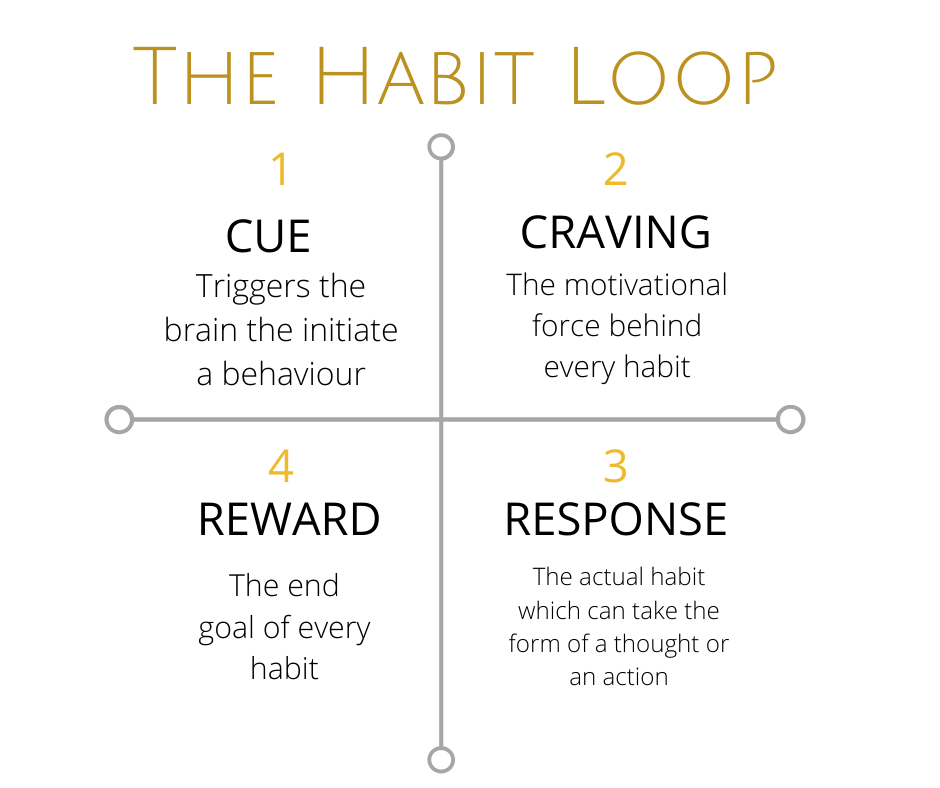
Building habits is a cycle of action and reflection. Use feedback to refine your approach:
Cue: What triggers the behavior?
Craving: What makes it desirable?
Response: What action follows the desire?
Reward: What makes the habit satisfying?
Track your progress with a simple journal or app. Seeing your streak of success creates momentum and reinforces your commitment.
Start Small and Build Momentum
Change doesn’t require perfection; it requires consistency. Start with one small habit that feels manageable. Once it becomes automatic, stack it with another habit. This technique, called habit stacking, anchors new habits to existing routines.
For example:
After I pour my morning coffee, I’ll do 5 deep breaths.
After I brush my teeth, I’ll write one line in my gratitude journal.
Stacking habits makes them easier to integrate into your life.
Reflect and Choose Your Focus
To identify your focus, think about the area of your life where you’d like to feel more vitality. Break it down:
What’s one challenge you face in that area?
What behaviors contribute to the problem?
Which habit can you start that feels simple yet impactful?
Example:
Area: Poor sleep.
Behaviors: Late-night screens, inconsistent bedtime, caffeine in the evening.
Chosen habit: Set a 9 PM screen-time cutoff for 30 days.
The Path to Vitality
Habits shape your life, and by learning to build better ones, you lay the groundwork for lasting vitality. It’s about savoring the process of small, meaningful changes, like enjoying a favorite song, where the joy comes from experiencing every note, not rushing to the final chord.
You are the barrier, and you are the path. Start today, one step at a time.
References
Lally, P., Van Jaarsveld, C. H. M., Potts, H. W. W., & Wardle, J. (2010). How are habits formed: Modelling habit formation in the real world.
Wood, W., Quinn, J. M., & Kashy, D. A. (2002). Habits in everyday life: Thought, emotion, and action.
Amabile, T. M., & Kramer, S. J. (2011). The progress principle: Using small wins to ignite joy, engagement, and creativity at work.