

Last week, I shared a quote from one of my mentors that stopped me in my tracks.
She said:
“Discipline without understanding feels like punishment.”
The quote hit deep. But it was the follow-up that cracked something open:
“What belief am I holding on to that makes this feel like suffering instead of self-respect?”
That’s not a surface-level question.
That’s a mirror.
Because if you’re honest, you’ve had moments where change felt like punishment — even though you wanted it.
Why?
Because your attention was split.
One part of you wanted growth.
Another part wanted something else… just as badly.
Maybe you’ve felt it — your head says one thing, but your heart says another.
That’s what most people call resistance.
But resistance isn’t real.
It’s not a wall. It’s not the enemy.
It’s a signal — a split in desire.
And the more clearly you can see what’s really pulling you, the more power you have to lead yourself through it.
The Five Wants That Keep You Stuck
Psychologist Alfred Adler taught that each of us develops unconscious personality priorities — emotional needs we chase to feel secure, significant, or in control.
When these desires go unseen, they become blind spots. And not because they’re wrong, but because they become non-negotiable conditions for peace.
Here are the five most common wants that shape your behavior beneath the surface:
1. Superiority / Significance — “I must be impressive.”
The drive to stand out, prove your worth, and avoid feeling average.
Inner voice: “Please notice me.”
Fear: Being average, unremarkable, or unseen.
Feels like: Avoiding situations where you might not be the best. Hiding your effort if it’s not exceptional or impressive. Shame when you’re “just okay.”
Competing want: Validation > Growth
2. Control — “I must stay in control.”
The need to manage everything to feel safe, certain, and prepared.
Inner voice: “Please let me feel safe.” or “Please don’t let things fall apart.”
Fear: Chaos, uncertainty, or being unprepared.
Feels like: Stress when plans change. Tightness when you’re not in charge. Over-preparing for every scenario.
Competing want: Certainty > Flexibility
3. Comfort — “I must avoid discomfort.”
The instinct to seek ease, numb pain, and avoid emotional or physical tension.
Inner voice: “Please don’t make this hard.”
Fear: Pain — physical or emotional.
Feels like: Hitting the easy button. Eating when you’re not hungry. Skipping a workout because you’re “tired.” Checking out (with your phone?) instead of sitting with restlessness.
Competing want: Ease > Progress
4. Approval — “I must be liked.”
The pressure to be agreeable and shape yourself to avoid conflict or rejection.
Inner voice: “Please like me.”
Fear: Judgment, conflict, or being misunderstood.
Feels like: Saying yes when you mean no. Shaping your actions to avoid disapproval. Swallowing your truth to keep the peace.
Competing want: Acceptance > Authenticity
5. Belonging — “I must be needed.”
The fear of being excluded, forgotten, or no longer valuable to others.
Inner voice: “Please keep me.”
Fear: Rejection. Being alone. Feeling like a burden.
Feels like: Guilt for setting boundaries. Overextending yourself to stay included. Losing yourself in the role you play — and forgetting the person you are.
Competing want: Connection > Self-responsibility
Why This Matters for Transformation
Each of these wants becomes a rule wired into your nervous system:
“I can only be okay if I succeed… stay in control… feel comfortable… get approval… stay connected.”
But growth threatens that.
Want to grow? You’ll have to let go of control.
Want to heal? You’ll have to stop chasing approval.
Want to get strong? You’ll need to be a beginner again.
Want to evolve? You’ll have to feel discomfort.
Want to lead yourself? You’ll have to do it without permission.
Want to be free? You’ll have to stop needing to feel safe first.
Real change always disrupts the very pattern you’ve used to feel safe.
But that disruption isn’t danger — it’s invitation.
The body resists because it craves safety.
The mind resists because it clings to certainty.
The heart resists because it fears rejection.
But when you slow down and face the pull beneath your pattern, you reclaim choice.
Think of readiness like a wheel. Not enough spokes, and the ride gets bumpy.
It’s not “you’re ready or you’re not.” You don’t need every spoke to be perfect. You just need enough integrity in the wheel to roll.
It’s about having enough structural alignment (emotional clarity, safety, belief, and energy) so that your system can support movement without collapsing.
Readiness is about capacity. “Can my system support movement?”
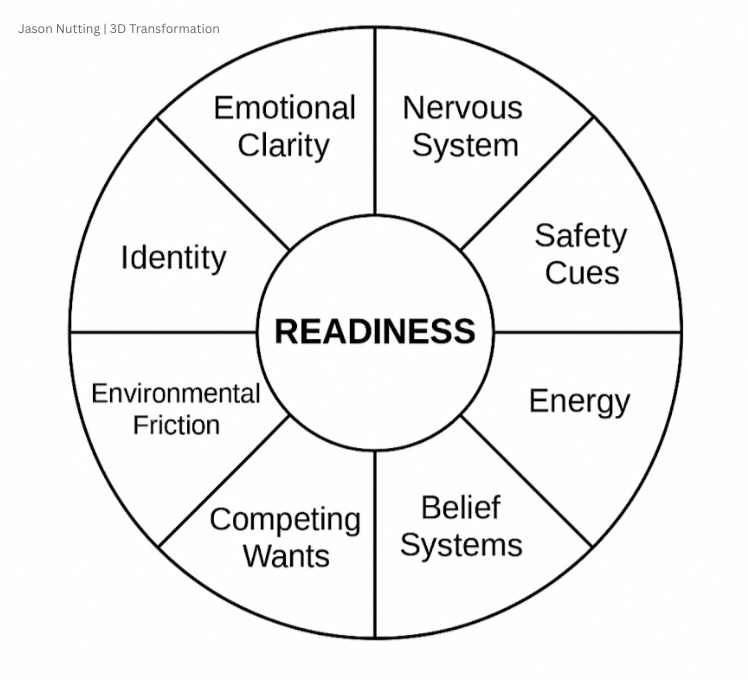
Check your stuck points. Often, it’s not about the plan, but the system holding it.
Willingness is about courage. “Will I actually move into discomfort?”
You can be willing… but not ready enough.
Or ready… but not willing enough.
Real change requires both.
This is where most people get hung up:
Most people want change… but most people aren’t yet willing for what change demands.
There is a gap between desire and action. Courage is the bridge.
Here’s how I map that journey:
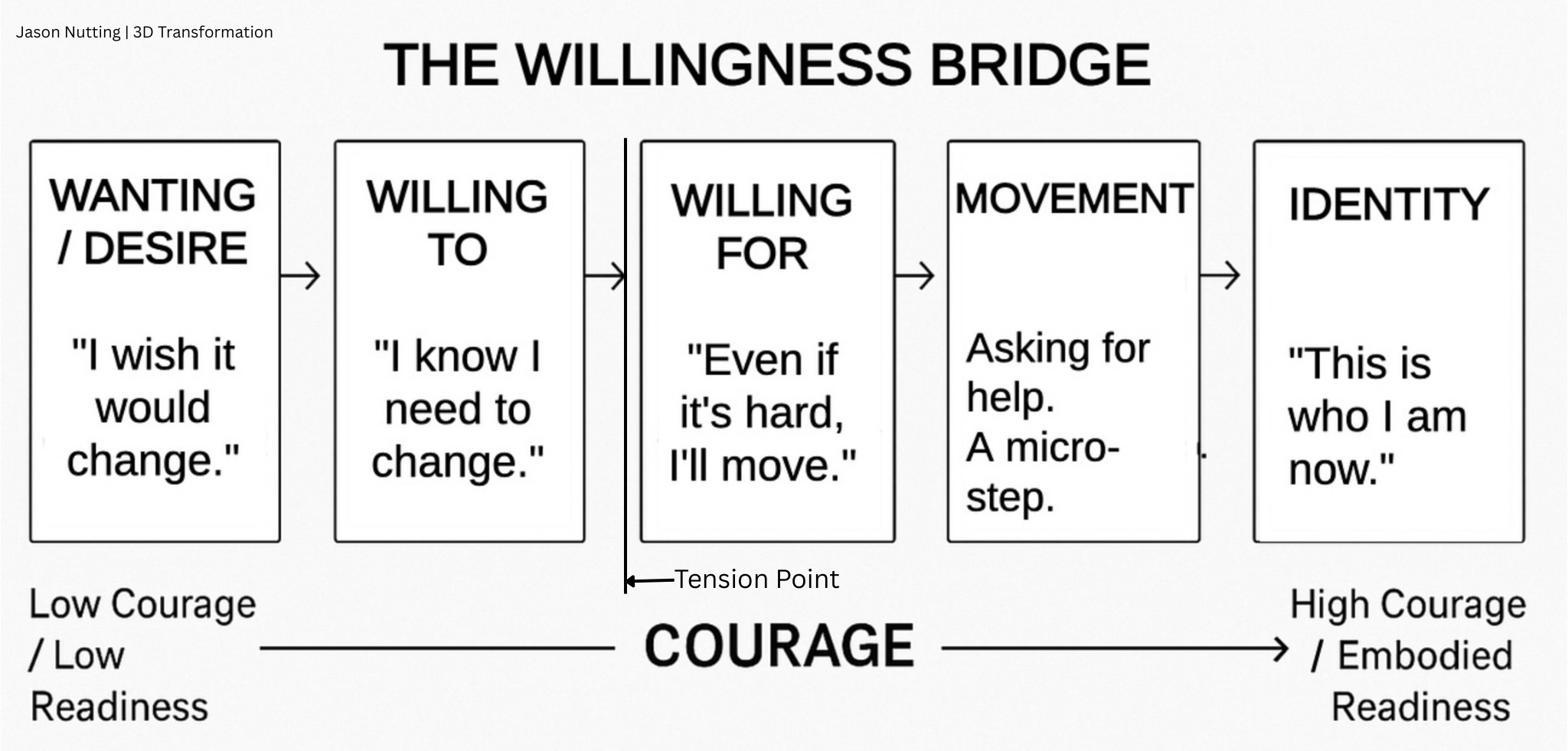
The truth is, many never move past “Willing To”.
The fear kicks in, the pull of comfort wins, and they stay looped in longing.
But once you’re “Willing For” discomfort, even micro-movement becomes possible.
And that’s where identity starts to shift.
From Insight to Action: The 5 Levers
These hidden wants show up everywhere, but they scream loudest through your health behaviors.
Here’s how to spot them using the five levers of transformation:
🏋️♂️ Exercise
“Am I training to grow — or to prove something?”
🥦 Nutrition
“Is this about nourishment — or control, fitting in, or checking out?”
😴 Sleep
“What part of me resists stillness, rest, or recovery?”
🧘♂️ Stress Management
“What am I afraid I’ll feel if I stop pushing?”
🔁 Behavior Change
“When I quit, avoid, or overcommit — which want is pulling the strings?”
💡 And through it all:
“Am I giving my best from a grounded place within me, or from fear, pressure, or proving?”
This isn’t about effort versus ease.
It’s about the energy behind your effort.
The more honest your answers, the more aligned your actions become.
The Choice Point
Can you sit with the want… and still choose the goal?
That’s the real work.
You will feel the tug of the old desire.
That’s the moment of choice.
Real self-leadership isn’t about avoiding the pull.
It’s about staying awake when it shows up, feeling it fully, and choosing anyway.
That does take willpower.
But not to fight yourself.
To direct your will toward the future you’ve chosen,
even when it doesn’t feel like the easy or obvious path in the moment.
That’s clarity and alignment.
That’s leadership.
Wanting isn’t the problem.
Unconscious wanting is.
The goal isn’t to kill your desires.
The goal is to see them clearly, and stop letting them lead from the shadows.
Because once you name the pull, it loses its grip.
And once you’re no longer being run by it, you can lead with calm, strength, and clarity.
Let go of needing to be exceptional, in control, comfortable, or approved of…
and what’s left is space.
In that space is peace.
And in that peace is power.
Because now, your actions don’t come from pressure…
They come from presence.
Peace in the heart creates order in the mind.
Order in the mind creates integrity in action.
And integrity in action creates transformation.
The Integration: Head. Heart. Hand.
“Intention gives you direction — the ‘why.’
Attention gives you focus — the ‘what.’
Attitude gives you quality — the ‘how.’”— Kamlesh Patel
That’s how you align Head, Heart, and Hand.
So the goal isn’t just reached…
It’s embodied.
Jason,
There’s a wealth of insightful information here about the power of self-observation and practical strategies for personal growth. The advice is incredibly helpful! I hope many people benefit. A suggestion, though likely not in your wheelhouse: to make these teachings more relatable and engaging, imagine short, humorous videos that showcase real-life examples. Picture using a lighthearted tone to demonstrate both the obstacles we face and the solutions we can apply. These videos could be easily shared on social media, helping to reach a broader audience. A touch of humor could drive the point home in a way that's both entertaining and memorable. As a visual learner myself—and likely many others—it would really bring the concepts to life.
BILL M