

"I know what to do… I just don’t do it."
Sound familiar?
This isn’t a motivation problem.
It’s a perception problem… specifically, how you see yourself in the moment a decision is made.
Because you don’t act from what you know.
You act from who you believe you are.
Most people try to change behavior without ever shifting identity.
But perception is the bridge between the two.
And when that shifts, everything changes.
Here’s the arc:
Awareness — to see clearly
Discernment — to separate truth from noise
Perception shift — to reorient identity
Aligned action — not forced willpower, but natural follow-through from a clearer self
This is the way.
It’s not the easiest to walk, sell, or teach.
But it’s the only path that leads to sustainable change… without self-betrayal.
By now, you’ve started building the three core skills of discernment:
You’re noticing what’s happening inside you.
You’re staying with emotions without getting pulled under.
You’re focusing your attention with more intention.
But even when you’re grounded... even when you’re aware...
something still gets in the way of aligned action.
You know what you should do.
But something inside you resists. Or hesitates. Or forgets.
That "something" is your perception.
But not the kind you see with your eyes.
This is the deeper kind—how you perceive yourself in the moment.
Perception Isn’t Binary—It’s a Continuum
Most people treat perception like a light switch:
"I’m either present or I’m not."
"I’m either clear or I’m triggered."
"I’m either grounded or I’m lost."
But perception doesn’t work that way.
It’s not a switch. It’s a sliding scale.
On one end, you’re fully fused with your emotion or thought:
"I am this anxiety."
"I am this failure."
"I am this story."
There’s no space between you and the experience. You are the storm.
But as perception shifts, something subtle happens:
You go from being the anger...
To feeling it.
To observing it.
To responding from something deeper than it.
And when you move far enough along that continuum, you reach clarity.
From that space, you don’t need to resist or obey the emotion.
You can see it—and still choose your next step.
Practiced Identity vs. Present Identity
Here’s the trap:
You’re not acting from your values.
You’re acting from your practiced identity.
That’s the version of you that’s:
Familiar
Rehearsed
Emotionally safe
Shaped by your past
This identity formed out of survival:
"I have to prove myself."
"I’m the one who fixes everything."
"I can’t show weakness."
"If I let go, everything will fall apart."
This version feels real, because you’ve worn it for so long.
But it’s not your truth.
It’s a rehearsed defense.
Present identity—the one rooted in clarity and intention—only becomes available when perception shifts.
You don’t destroy the old self.
You just stop feeding it.
How the Continuum Works (Real-Time Shift)
Here’s what a perception shift looks like in motion:
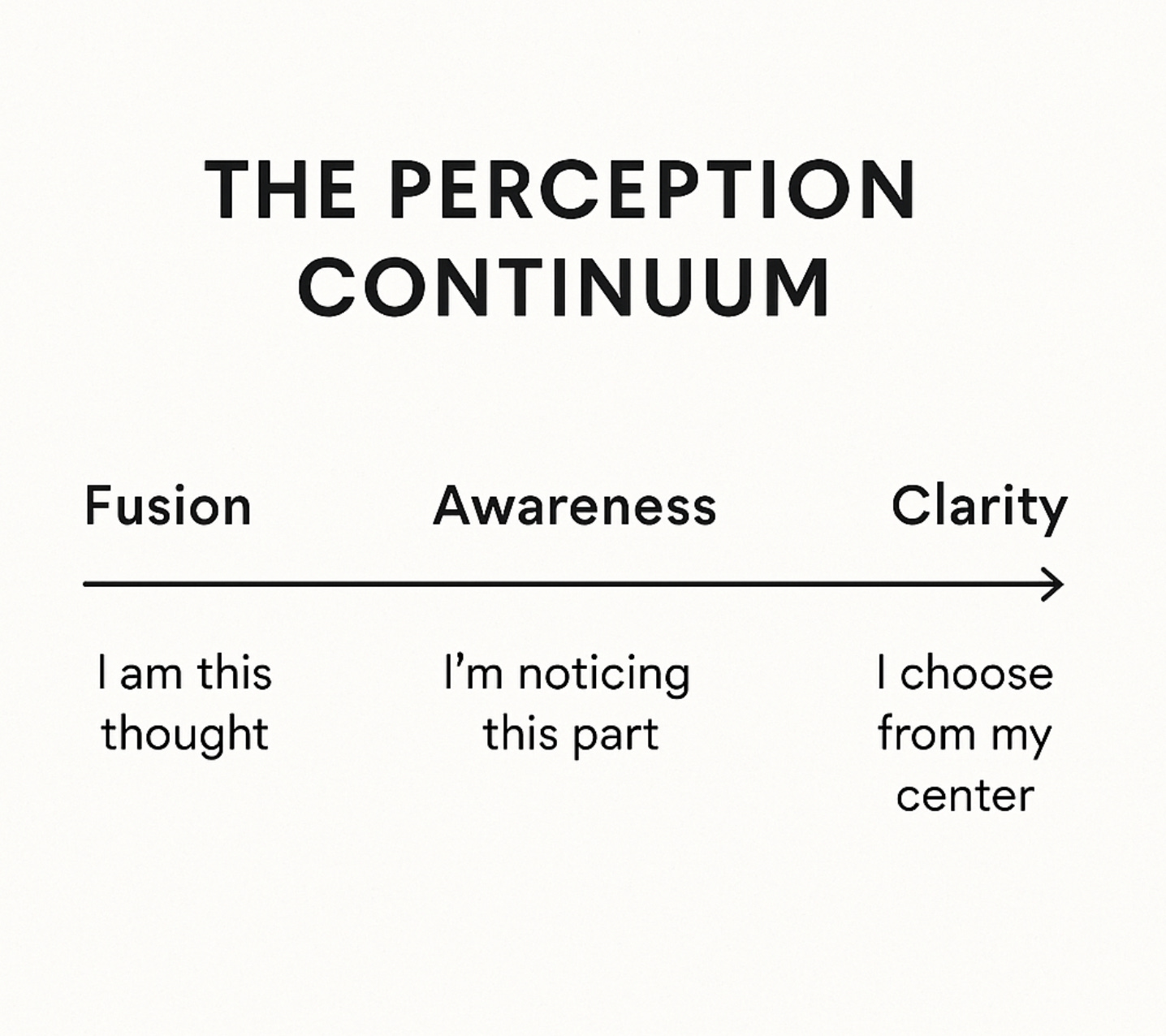
Fusion: "I’m angry. They’re wrong. I have to make this right."
Awareness: "I’m angry. My chest is tight. My jaw is clenched."
Space: "Something in me feels threatened. But I can breathe here."
Observation: "This is a part of me—probably trying to protect or defend."
Discernment: "What do I want to be true in this moment?"
Alignment: "From my center, I choose to speak with clarity instead of reaction."
This isn’t about suppressing your truth.
It’s about letting your deepest truth lead—not the loudest emotion.
The 5% Shift That Changes Everything
You don’t need a breakthrough.
You don’t need 100% clarity.
You just need a 5% shift.
That’s all it takes to move from fused to aware.
From reactive to reflective.
From stuck to self-led.
That 5% might be:
A breath
A hand over your heart
A pause before the text
A question: "Is this really me—or just the old story?"
Small shift. Big pattern change.
The Formula: Perception → Interpretation → Action
Here’s the chain:
Perception: How you see yourself in the moment
Interpretation: What story you create about what’s happening
Action: How you respond
If your perception is off, your story will be off.
And your actions will reflect a distorted truth.
But when perception clears, even slightly, the story changes:
You don’t spiral.
You don’t personalize.
You don’t default to your past.
You lead from your center.
Why This Changes More Than Just Your Mind
This isn’t just about clarity or emotional intelligence.
It’s about everything you say you want:
The body you’re trying to build
The nutrition plan you’re trying to follow
The sleep you keep saying you’ll fix
The stress you want to manage
The habits you’re tired of breaking
The version of you you’re trying to become
Because here’s the truth:
You don’t act from what you know.
You act from who you believe you are in the moment.
So if your perception hasn’t shifted—if you're still seeing yourself as the stressed one, the tired one, the one who never finishes—then no amount of motivation will stick.
Until perception changes, effort feels like a fight. (the compelling pull)
After it changes, effort becomes alignment. (the validating shift)
You don’t just “try to be healthy.”
You embody someone who values their health.
You don’t just “push through.”
You make decisions from a grounded identity that can hold discomfort without losing direction.
This is why perception training isn’t optional.
It’s the foundation of every result you care about.
Perceptual Blindness
Sometimes, the problem isn’t what you’re doing.
It’s that you don’t even see that you're doing it.
This is perceptual blindness: when you’re so fused with a thought, emotion, or identity that you can’t step outside it long enough to question it.
You become the pattern, the urgency, the excuse.
You move too fast to notice it, too often to question it.
And this is why you stay stuck: because you’re trying to fix a problem without realizing you’re still reinforcing the identity that created it.
As Thomas Keating said:
"For us to be habitually happy, nobody has to change except ourselves."
But to change, you first have to see.
And to see, you have to slow down.
That’s why I teach two anchor tools:
The Reality Check helps you interrupt the thought and test the belief.
Example: You think, "I can’t change." The Reality Check asks—Is that true? What is that belief costing you? If you believe you can’t, do you think you will? (read more here)
The Release Method helps you let go of the emotional residue and tension behind it.
Example: You feel grief, shame, or craving so strong it paralyzes you. You know what to do, but your body won't move. The Release Method creates space to feel it fully—so it loosens its grip and no longer leads your action. (read more here)
Together, they help you break out of the loop.
They help you see the blind spot, feel what’s really there, and return to the part of you that can choose a new direction.
A Practice to Train Perception Shifts
Try this the next time you feel reactive:
Name the part: "What part of me is active right now?"
Check fusion: "Am I fused with it—or can I observe it?"
Choose a shift: "What breath, gesture, or phrase brings me back to center?"
Lead from center: "From that space, what’s the next right step?"
You’re not fixing.
You’re focusing.
Once you’ve reconnected to presence... what do you do with it?
If you change how you see yourself in the moment, you change what you’re capable of in your life.
This is the skill most people never train.
It’s not about becoming someone new through pressure, but about becoming someone more true through discernment and self-leadership.
It’s about returning to the part of you that’s always been clear, and choosing from there.
That’s freedom.
That’s the way forward.
Let’s keep going.
If this helped you shift something inside, forward it to a friend.