

This is where our relationship to effort begins to shift.
We’re raised to set goals, chase outcomes, and measure progress.
But few stop to ask the real question: what are we actually committing to?
A goal defines an outcome.
A plan defines a process.
An intention defines a purpose.
You can plan and you can intend, but you can’t control a goal.
That’s the trap of the modern achiever: trying to commit to something that lives outside your control.
When you stop chasing outcomes and start aligning with purpose, most people think that you’ll lose ambition, but the reality is that you gain power.
Two Modes of Living
There are two fundamental ways to live: cause-driven and purpose-driven.
The cause-driven life moves from what caused this?
The purpose-driven life moves from what is this for?
Philosophically, this mirrors two scientific models of motion:
The kinetic (cause-based, linear, measurable)
The energile (purpose-based, adaptive, living)
One focuses on external forces, and the other on internal direction.
The Cause-Driven Life
The cause-driven life is built on doing.
It’s the world of performance metrics, timelines, and control.
You start in the valley, climb the mountain, and measure progress by height gained.
There’s nothing wrong with this, and in fact, it’s how we build skill, achieve mastery, and create results.
But when every action is chained to a cause, meaning becomes conditional.
You end up doing life instead of being life.
You climb faster, but feel emptier.
You achieve more, but experience less.
Truth is, this is an illusion.
There are no causes, only misunderstood purposes.
Every behavior (even the ones that keep us stuck) began as an attempt to meet a need or protect a wound.
When we uncover the positive intent beneath our goals, we often find that what we’ve been chasing wasn’t wrong, just misdirected.
The point isn’t to condemn ambition, but to clarify its direction. To find healthier ways to meet the same need (to feel capable, connected, and worthy) without proving that nothing was ever missing to begin with.
The Purpose-Driven Life
The purpose-driven life operates differently.
It’s not about escaping the valley, but engaging the climb itself.
It’s teleological, meaning it’s driven by ends, not causes; by meaning, not mechanics.
It doesn’t ask “What made this happen?”
It asks “What is this moment asking of me?”
This is the shift from force to flow, from control to connection.
It’s not about what you’re getting out of life, but what life is trying to express through you.
The purpose-driven life is about being part of life, not managing it.
It’s where you stop trying to become something and start embodying who you already are.
Goal vs. Intention
When you live cause-driven, your energy chases goals.
When you live purpose-driven, your energy expresses intentions.
A goal is a finish line.
An intention is a compass.
A plan is simply the bridge between the two.
Goals define what you want to achieve.
Intentions define how you want to live while you achieve it.
That distinction changes everything.
My goal might be to grow my business.
My intention is to lead with integrity and serve from love.
My goal might be to hit a new PR.
My intention is to embody strength, courage, and discipline.
Goals measure outcomes.
Intentions cultivate identity.
Most people try to build identity through achievement, or by filling an inner void with outer proof.
But identity isn’t built by outcomes; it’s revealed through intention.
Purpose fills from within what success keeps trying to fix from the outside.
Self-realization reveals the wholeness within us; purpose carries that wholeness into the world.
The journey inward finds truth, but it’s the journey outward that gives it away.
When Goals Serve Intentions
When goals serve intentions, achievement becomes meaningful work.
Progress doesn’t pull you away from presence, it deepens it.
You’re still ambitious.
You still build.
But you no longer climb out of fear of being behind.
You climb because movement itself is an act of devotion.
You shift from chasing: Having → Doing → Being
To expressing: Being → Doing → Having
The Integration
In physics, kinetic energy is energy in motion.
Energile energy (from Aristotle’s energeia) is energy in being, or the activity of something fulfilling its nature.
That’s the choice every day:
Will I move from cause or purpose?
Will I live kinetically, reacting, pushing, forcing?
Or energilely, expressing, responding, unfolding?
Both matter.
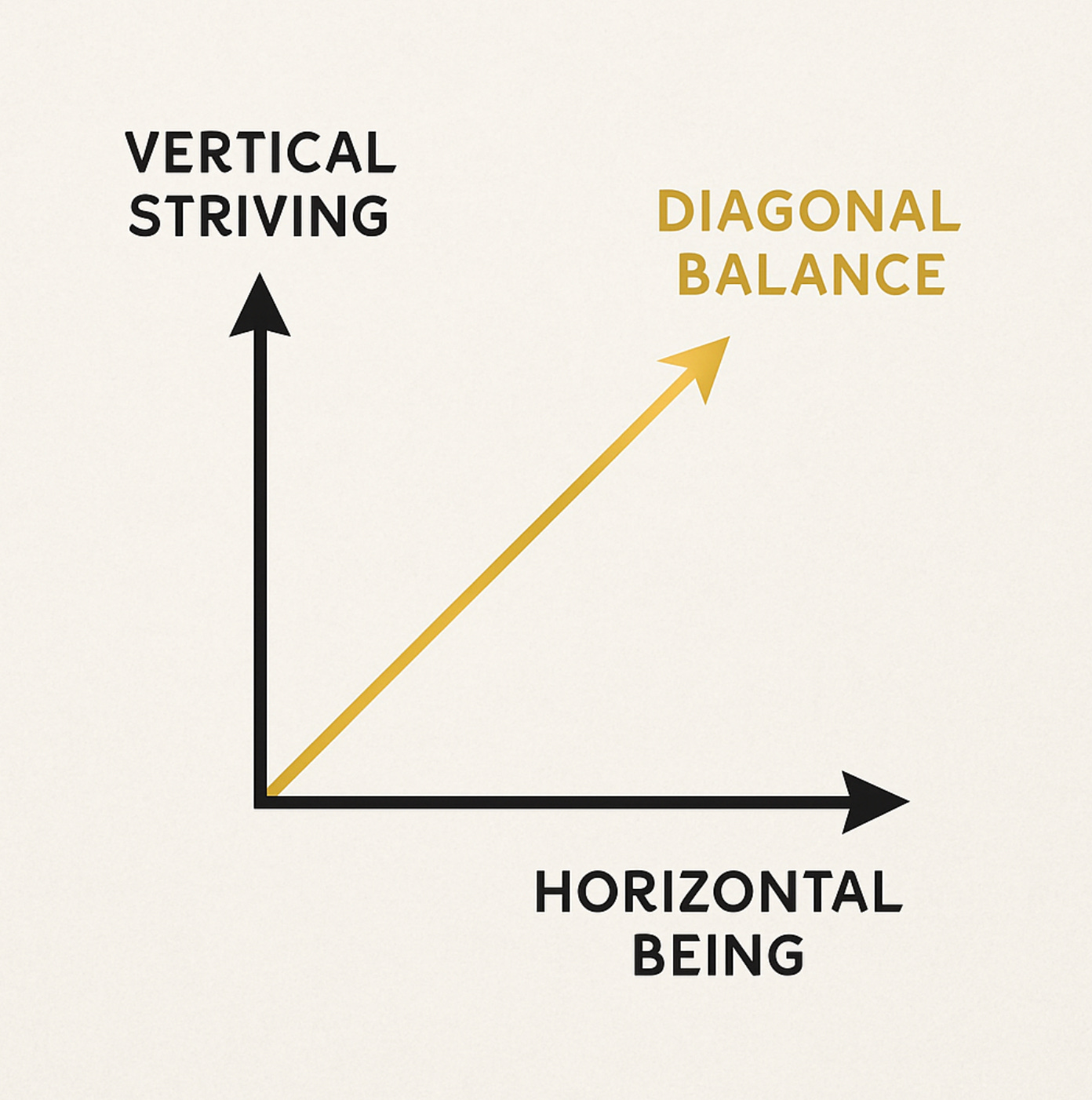
But mastery is learning when to do and when to be.
This distinction isn’t just philosophical, it’s practical.
It shows up in the gym, in the kitchen, and in your daily mindset.
A cause-driven approach to fitness or nutrition says,
“If I eat clean and train hard, I’ll finally feel confident.”
A purpose-driven approach says,
“I train to honor my body, to build energy, to express strength.”
One chases results to fix a feeling.
The other uses habits to express identity.
Whether it’s food, exercise, stress management, or behavior change, the question isn’t
“What will this get me?”
It’s…
“Who am I choosing to be through this?”
This balance is the middle path where action meets awareness, and doing flows from being.
Practical Reflection
What am I intending today?
If every goal disappeared, what would still give my actions meaning?
Am I doing life, or being part of life?
Because the world doesn’t need more people chasing goals.
It needs more people whose goals are aligned with their intention…
whose doing flows from their being,
and whose purpose fuels their progress.
Stop living to cause change. Start living to embody purpose.
That’s when effort becomes energy, and life stops being something you do, and starts being something you are.

The Missing Link Between Change and Freedom

We all chase change, but most of us are only rearranging our defenses.


