

Most people wake up already moving.
Checking something.
Thinking about something.
Carrying yesterday into today before the day has even really started.
Then the day begins pulling.
Messages.
Responsibilities.
Deadlines.
Conversations.
Noise.
Pressure.
One thing after another after another.
And honestly, if you live this way long enough, you stop questioning it.
You assume this is just what being an adult feels like.
But over time, something subtle starts happening.
You stop living from clarity and start living from momentum.
You stop consciously participating in your days and start reacting to them.
Not dramatically.
Quietly.
A little more automatic.
A little more emotionally pulled by stress, comfort, distraction, pressure, and exhaustion.
A little less connected to yourself beneath all the movement.
Until eventually life starts feeling mechanical.
Wake up. Push through. Escape. Repeat.
Most people try to solve this by changing one thing.
A new workout plan.
A new diet.
A better morning routine.
More discipline.
More motivation.
A productivity system.
But isolated changes rarely last, because the deeper issue usually isn’t the plan.
It’s the condition of the person trying to follow the plan.
You can know exactly what to do and still not do it consistently.
Not because you’re lazy.
Because somewhere throughout the day, you lost contact with yourself.
That’s the real problem.
Most people drift unconsciously, then try to fix their life from the drifted state.
The Rule of Life is meant to interrupt that.
Not with pressure.
Not with perfection.
With rhythm.
A Rule of Life is simply a structure for returning.
Returning before the noise completely takes over.
Returning before stress becomes unconsciousness.
Returning before one bad moment becomes a bad day… then a bad week… then a life that no longer feels aligned.
Because you will drift.
Everyone does.
The question is whether you have a way to come back.
The Four Practices
The Rule of Life is built around four daily practices:
Morning — Homecoming
Day — Belonging
Stretch — Striving
Night — Letting Go
Each one interrupts a different form of unconsciousness.
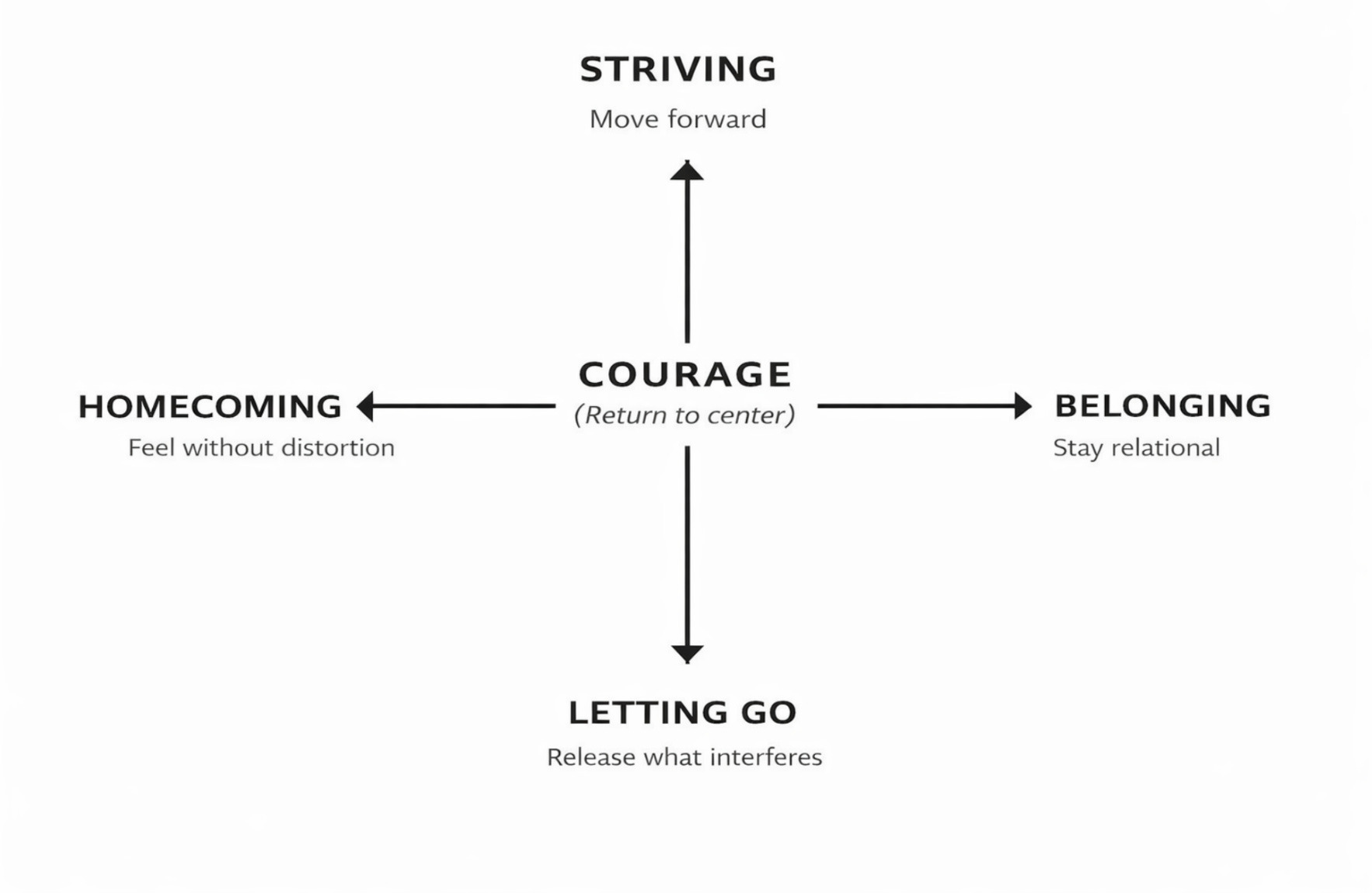
At a deeper level, this is what the rhythm is doing:
Homecoming → connection to self
Belonging → connection to others
Striving → action
Letting Go → release
Without courage, Homecoming becomes avoidance, Belonging becomes approval seeking, Striving becomes proving, and Letting Go becomes passivity.
Together, they create rhythm.
Not rigid control.
Not self-optimization.
A way of staying connected to yourself while living a real life.
Morning — Homecoming
Before the world starts speaking…
return to yourself.
Before the notifications.
Before the pressure.
Before the demands.
Before the identity you perform for everyone else.
Sit.
Not to achieve anything.
Not to become “better.”
Not to force peace.
Just to stop abandoning yourself before the day even begins.
Most people wake up and immediately leave themselves.
Phone. Thoughts. Stress. Planning. Reacting.
Their attention gets pulled outward before they’ve even fully arrived.
This practice interrupts that.
This is the sunrise practice.
The awakening practice.
A return to reality before the noise of the day starts distorting it.
You are reminding yourself:
I am here.
I am aware.
I do not have to begin the day unconsciously.
And strangely, that alone changes the quality of the day.
Because when you begin from yourself, you are less likely to spend the rest of the day searching for yourself in distraction, urgency, food, stimulation, validation, or escape.
Practice:
Sit quietly for 10–15 minutes. No phone. No input. Just return.
Day — Belonging
Most people spend the majority of their life working, moving, helping, building, solving, responding, and carrying responsibility.
But mentally, many people are somewhere else.
They are waiting for life to start later.
After work.
After the weekend gets here.
After a vacation.
After things calm down.
But your life is happening now.
Right in the middle of ordinary things.
Belonging is the shift from:
“I have to” → “I get to contribute.”
It is the recognition that your presence affects people.
The way you speak to someone.
The energy you bring into a room.
The effort you give something.
The patience you carry.
The integrity behind small actions no one sees.
Most people think meaning comes from dramatic purpose.
Usually it comes from participation.
From bringing yourself fully into the life already in front of you.
Belonging is not about being liked.
It is about remembering:
I am part of something larger than myself.
And that changes the emotional tone of the entire day.
Work becomes contribution.
Responsibility becomes service.
Ordinary moments stop feeling empty.
Practice:
Choose one part of your day and deliberately approach it with contribution instead of obligation.
Stretch — Striving
Every day should contain one deliberate act of growth.
One moment where you stretch beyond your current comfort, mood, or conditioning.
Not because suffering is noble.
Because comfort slowly turns unconscious when it becomes your default.
Most people already know the areas where they are avoiding growth.
The hard conversation.
The workout.
The apology.
The discipline.
The honesty.
The boundary.
The uncomfortable next step.
That quiet pull? That moment where something in you wants something else?
That’s usually the doorway.
Striving means voluntarily stepping toward what strengthens you instead of constantly obeying what soothes you.
Not recklessly.
Not obsessively.
Not from self-hatred.
Because growth requires friction.
And if you never intentionally challenge yourself, life eventually does it for you.
This practice keeps you from becoming passive inside your own life.
It reminds you that transformation is not found in ideas alone.
It is built through lived action.
Through moments where you choose what matters over what feels easiest in the moment.
Practice:
Do one thing each day that stretches you beyond comfort. Cleanly. Deliberately. Without unnecessary drama.
Night — Letting Go
Most people never truly end the day.
They carry it.
The stress.
The conversations.
The tension.
The pressure.
The regret.
The unfinished mental loops.
And then they wake up already heavy.
So after the day’s work, release it.
Not by solving every problem.
Not by mentally replaying the entire day.
By putting down what no longer needs to be carried.
Sit again.
Let the mind slow down.
Let the day settle.
Notice what still feels emotionally hooked inside you, and instead of gripping tighter, let it move through.
This is the evening cleaning practice.
A return to simplicity.
Not performative like a task or ritual.
Experiential; a dropping of effort.
A willingness to stop dragging psychological residue into tomorrow.
Then, before sleep, remember what matters.
Who you are trying to become.
How you want to live.
What kind of life you are actually building.
Or whatever “remember what matters” means to you.
Don’t try to do it perfectly.
Just honestly.
You do not need to figure your whole life out at night.
You just need to stop carrying what does not belong to tomorrow.
Practice:
Sit quietly for 10 minutes before bed. Release the day. Return to simplicity. Remember what matters.
That’s the Rhythm
Morning — Homecoming
Day — Belonging
Stretch — Striving
Night — Letting Go
A rhythm for coming back before you drift too far away from yourself.
Because drifting is normal.
Life is loud.
Pressure is real.
Distraction is everywhere.
The goal is not perfection.
The goal is awareness.
To notice sooner.
To reconnect faster.
To stop living the majority of your life unconsciously.
Over time, something begins to change.
You stop trying to force yourself to “hold it all together” from morning until night.
Because now you have reconnection points built into the day.
You know how to return.
You know how to contribute.
You know how to grow.
You know how to release.
And eventually, you begin to trust something deeper:
Even when life pulls you away…
you know how to come back.
FREE RESOURCE DOWNLOAD:
I also created a more detailed Rule of Life framework for people who want to build their own structure and daily rhythms around these ideas.


The Doorway Out of Yesterday

Most people think imagination is child’s play. It’s nothing more than a mental escape, a fantasy engine, a way to dream about a life they’ll never actually live.
