

Most people think fat loss means one thing: eat less, exercise more, and hang on until willpower runs dry. That’s not a plan. That’s punishment.
And the result is predictable: you stall, you get hungrier, your workouts feel harder, and the scale won’t budge.
You’ve probably felt it: the grind, the cravings, the frustration when you’re doing “everything right” but nothing’s changing.
You blame yourself for “lack of discipline,” when in reality, the system itself is broken.
The truth? Your body is adaptive.
The longer and harder you push, the more it pushes back—slowing metabolism, ramping up hunger, draining energy. That’s why indefinite dieting doesn’t work.
What works is structure: set time frames, intentional cycles, and planned breaks.
Step One: Know Where You’re Starting
How lean you are determines how long you can push before your body forces a reset.
Category 1 – Men ≤15%, Women ≤24%
→ Already fairly lean. Can push 4–6 weeks before needing a break.
Category 2 – Men 16–25%, Women 25–34%
→ Moderate body fat. Can usually diet 6–12 weeks before a break.
Category 3 – Men 26%+, Women 35%+
→ Higher body fat. Body tolerates 12–16 weeks of fat loss before needing a reset.
For reference: Contest-level leanness is 3–5% for men, 6–8% for women. Cover-model lean is ~8–10% for men, ~15–17% for women. Neither is realistic for lifestyle goals.
Key idea: the leaner you are, the shorter your sprint. The more you have to lose, the longer you can run before resetting.
The 4 Ways of Eating
Every nutrition strategy falls into one of two broad types:
Compensatory → you’re trying to “make up for” one side of the equation with the other. It works temporarily, but eventually backfires.
Balanced → food intake and activity are aligned to support your body, not fight against it. These are sustainable long term.
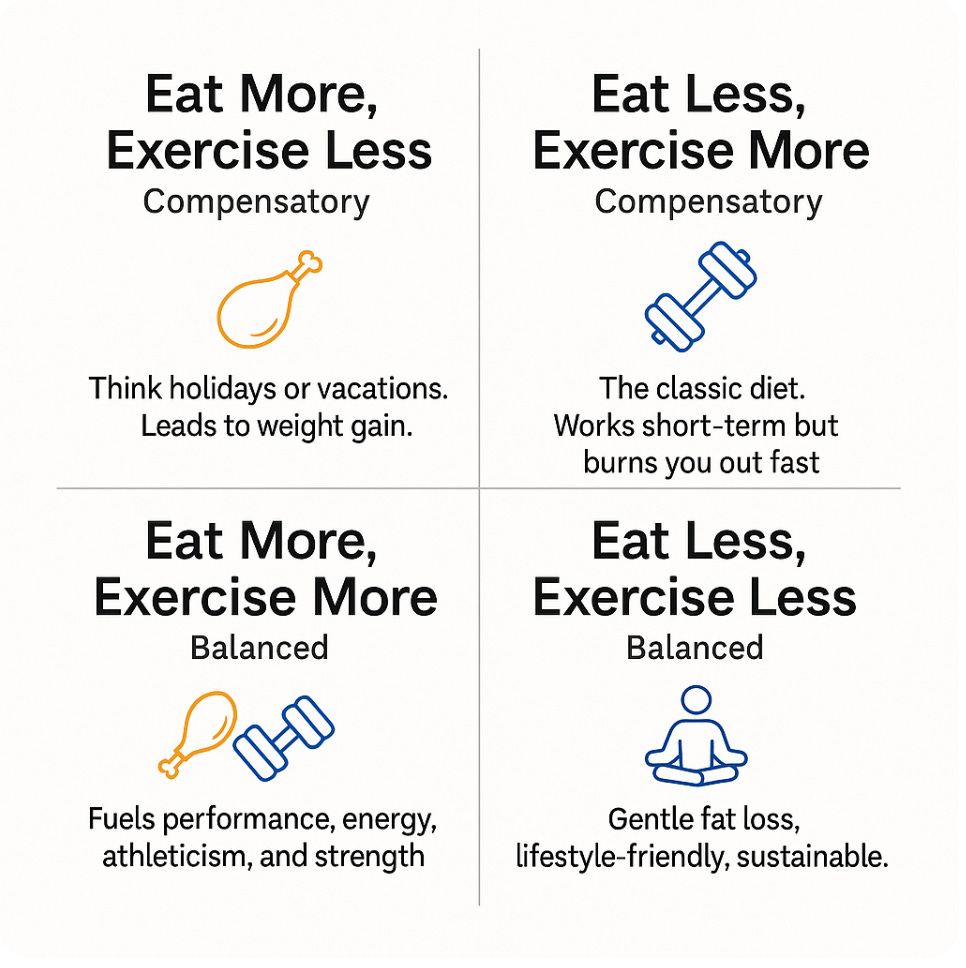
This can be broken down further into the 4 ways of eating:
Eat More, Exercise Less – Compensatory.
Think holidays or vacations. Leads to weight gain.
Eat Less, Exercise More – Compensatory.
The classic diet. Works short-term but burns you out fast.
Eat More, Exercise More – Balanced.
Fuels performance, energy, athleticism, and strength.
Eat Less, Exercise Less – Balanced.
Gentle fat loss, lifestyle-friendly, sustainable.
Most people chasing fat loss default to Eat Less, Exercise More. It works—but only as a sprint. Push too long, you stall, crash, and rebound.
Cycle it smart, and you keep progressing without losing your mind.
Why You Can’t Out-Train Your Fork
Exercise is incredible for health, strength, and mood. But it’s a lousy fat burner by itself.
One hard workout might torch 300–500 calories (probably more like 150-300). That’s wiped out with a single muffin from Starbucks.
If fat loss is the goal, nutrition is the lever. Exercise is the amplifier. Together, they work beautifully—but slash food too hard while stacking workouts, and you’ll burn out.
Rule: the more extreme the deficit, the shorter the cycle.
The Science of Adaptation
Here’s why cycles matter:
Metabolism slows → Resting energy use drops by 10–20%.
Hormones shift → Leptin (satiety) drops, ghrelin (hunger) rises.
Glycogen depletes → Muscles lose stored carbs and water, leading to quick but temporary weight loss.
NEAT decreases → You unconsciously move less (less fidgeting, walking, standing).
Research calls this adaptive thermogenesis, and it’s your body’s built-in defense against fat loss.
Metabolism slows more than expected, leptin can drop by up to 50% in just a week, and hunger hormones spike. This isn’t broken willpower, it’s biology.
That’s why structured breaks are essential if you want fat loss to stick.
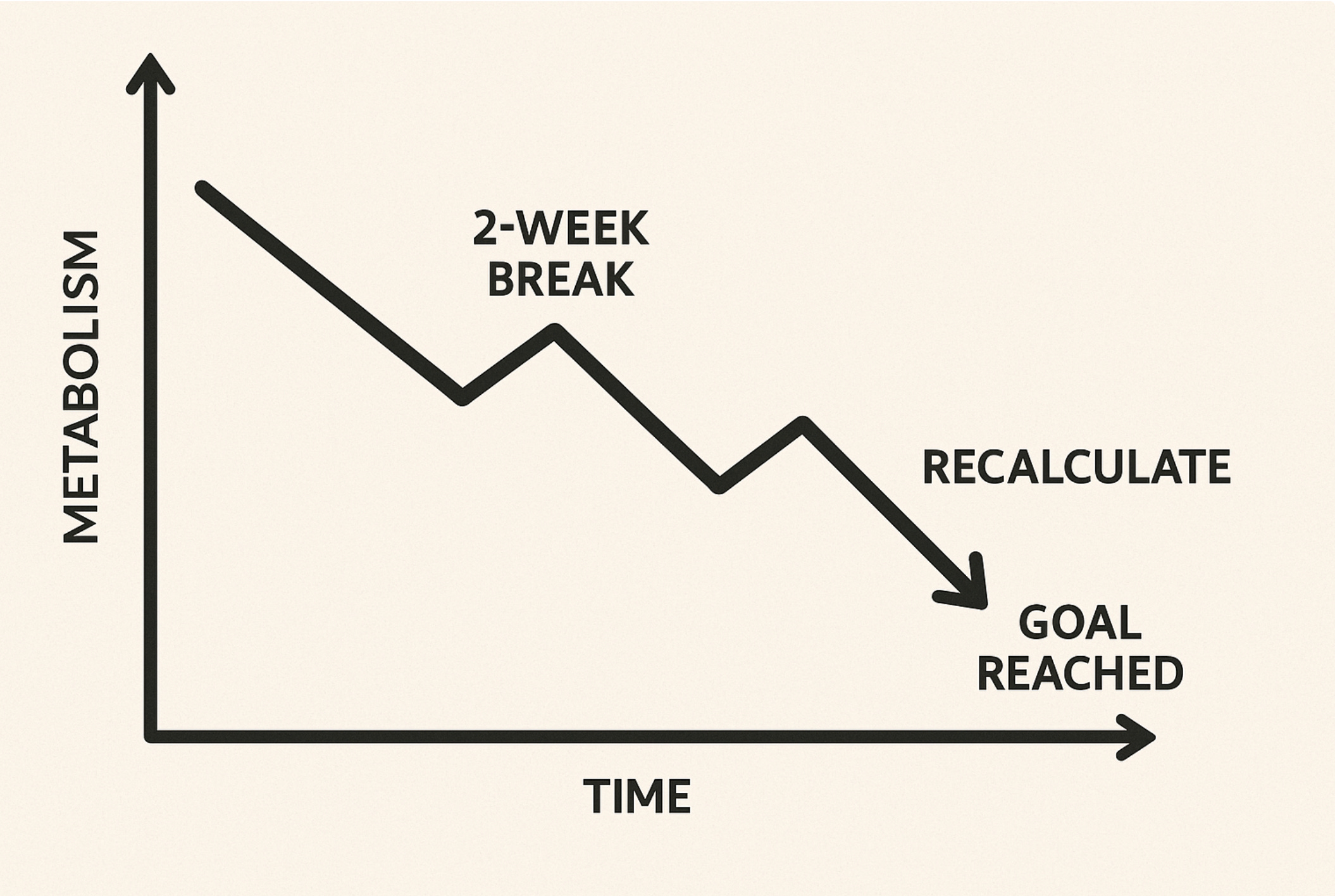
That’s why we insert maintenance breaks. A 2-week reset at maintenance restores glycogen, stabilizes hormones, and recharges metabolism. Then the next fat-loss phase works again.
The Rhythm That Works
Here’s the system in plain terms:
Pick your category (based on body fat %).
Plan your sprint (4–16 weeks depending on category).
Push fat loss (eat less, move more—on purpose).
Take a 2-week maintenance break. Expect to regain 2–3 lbs from glycogen and gut residue. That’s normal.
Repeat until you hit your goal.
How Much to Expect Per Cycle
A solid benchmark: about 10% of your body weight over 12 weeks.
That usually works out to:
Category 1 (Lean) → 0.5–1% of body weight per week.
For a 150 lb person, that’s ~0.75–1.5 lbs/week.
Category 2 (Moderate) → 0.5–1% per week
~1–1.5 lbs/week for most.
Category 3 (Higher) → closer to 1–1.5% per week.
For a 250 lb person, that’s ~2–3 lbs/week.
Percentages keep it relative to your size. Pounds make it easy to picture. Put together, you’ll know exactly what “realistic progress” looks like.
Take a 220 lb client I coached. As a Category 3, he ran a full 12-week sprint followed by a 2-week maintenance reset. His goal was 10%—about 22 lbs.
But here’s what actually happened: by sticking to the rhythm, hitting his nutrition, and not burning himself out, he lost 28 lbs in that first cycle.
More than his goal, but without extreme restriction or two-a-day workouts. That landed him right in the expected 1–1.5% per week range, proof the math holds up in real life.
And because he took that 2-week maintenance break, he kept his energy high, preserved muscle, and was ready for the next round.
That’s the power of cycling—progress that feels sustainable, not punishment.
Here’s a different example:
Category 2 (16–25% men / 25–34% women)
8 weeks fat loss → 2 weeks maintenance → 8 weeks fat loss → 2 weeks maintenance
In 20 weeks, that’s ~12–18 lbs down, steady, sustainable, and without burnout.
The key isn’t just the numbers—it’s the rhythm. Push in cycles, reset when it’s time, and keep stacking progress until you hit your goal.
The Psychology Advantage
There’s a reason cycles work: people push harder when they know there’s a finish line. Six weeks of focus feels possible—“forever” doesn’t. This is called the finish line effect. Clear start-and-stop points increase motivation, discipline, and follow-through.
But here’s the catch: when people only chase the end, they treat it like they’re “done.” They drop the very practices that got them results, and that’s why rebound weight gain is so common.
The real win is reframing your focus. Every choice you make in the present reshapes your identity. Each meal, each workout, each decision is proof: you’re becoming the person who consistently chooses health.
The balance is honoring human nature by using short-term finish lines for motivation—while remembering that the real transformation is happening right now, in the choices you make daily.
That’s what keeps results for life.
Final Word
Find your rhythm—short blocks of focus, planned breaks, and long-term momentum.
Forget punishment. Forget the endless grind.
Think like an athlete: train in seasons, fuel in cycles, and arrive at your goal with energy and confidence intact.
And here’s the best part: when you learn this system, you’ll never diet again—not in the old, restrictive sense.
Instead, you’ll reorient your relationship with food, reshape your habits, and eat in patterns that actually support your life.
Want me to help you identify your category and map your first cycle? Reply back. I’ll help you find your starting point.
References & Further Reading
The concepts of diet cycles, adaptive thermogenesis, and body-fat–based time frames aren’t new. They’ve been documented by researchers and coaches for years. If you want to dig deeper into the science behind this approach, here are some of the most useful resources:
Lyle McDonald – A Guide to Flexible Dieting, The Rapid Fat Loss Handbook, & others. (details the logic of diet breaks and refeeds, outlines category-based dieting and fat-loss time frames by body fat levels.)
Eric Helms, Andy Morgan, Andrea Valdez – The Muscle & Strength Pyramids (covers evidence-based nutrition frameworks and practical fat loss guidelines)
James Krieger – Research reviews on adaptive thermogenesis and diet breaks at Weightology.net
Kevin Hall, PhD (NIH) – Studies on metabolic adaptation during dieting
READ NEXT…


The First Blind Spot: Wanting

Last week, I shared a quote from one of my mentors that stopped me in my tracks.